
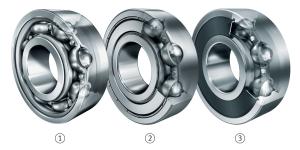
FAG single row deep groove ball bearings are available in open designs, as well as with seals on one or both sides. In the case of sealed bearings, either non-contact or contact seals are used.
Different seals are designated by different suffixes. The common seals for FAG bearings are as follows:
- 2RSR: Contact lip seals.
- 2Z: Non-contact sealing shields
- 2RZ: Non-contact seals
- 2HRS: Contact seals for Gen. C
- 2BRS: Non-contact seals for Gen. C
| Suffix | Type of seal +++ = excellent ++ = very good + = good o = satisfactory – = unsatisfactory | Seal characteristic | |||||
|---|---|---|---|---|---|---|---|
| low-friction running | high speeds | sealing integrity against ingress of water | sealing integrity against ingress of dust | sealing integrity against loss of grease | |||
| ‒ |  | open, without seals | +++ | +++ | – | – | – |
| Z, 2Z |  | non-contact (sheet metal), for standard bearings and Gen. C | ++ | +++ | o | o | o |
| RZ, 2RZ |  | non-contact (elastomer), for standard bearings | ++ | +++ | o | o | o |
| BRS, 2BRS |  | non-contact (elastomer), for Gen. C | ++ | +++ | o | + | + |
| HRS, 2HRS |  | contact (elastomer), for Gen. C | o | + | ++ | ++ | ++ |
| RSR, 2RSR |  | contact (elastomer), for standard bearings | o | + | + | ++ | ++ |
| ELS, 2ELS |  | contact (elastomer), for Gen. C | + | ++ | ++ | +++ | +++ |
For more information, please refer to Shielded VS Rubber Seal bearings.
Contact seals 2RSR, 2RHS, 2ELS
As these seals are in contact with a defined contact pressure against their sliding surface, they provide very good sealing action against the egress of lubricant and ingress of moisture and dust. Attention must, however, be paid to the loss of energy resulting from friction at the sealing contact. Furthermore, in bearings with contact seals, the bearing speed is restricted by the permissible sliding velocity at the seal lip, i.e. the speed suitability of these bearings is lower than for open bearings or bearings with non-contact seals.
2RSR seals, for standard FAG bearings
2RSR seals are elastomer lip seals with a sheet steel reinforcement. One seal lip is in radial contact with the inner ring.
HRS and ELS seals for bearings of Gen. C
HRS and ELS seals are securely anchored in a recess in the outer ring. The sealing material is vulcanised onto a sheet steel reinforcement. The sealing washer, together with the inner ring, forms an axial sealing system. In addition, the outer non-contact lip forms a protective labyrinth with the inner ring. An additional increase in the sealing action is also provided by the film of grease between the two seal lips. With this sealing arrangement, higher speeds can be achieved than with conventional RSR seals , as the frictional torque and thus the heat generation in the bearing is lower.
Non-contact seals 2Z, 2RZ, 2BRS
Non-contact seals are particularly suitable for applications with high speeds and high requirements for low heat generation. They are free from friction, except for a small amount of lubricant friction in the sealing gap. As a rule, non-contact seals do not undergo wear and therefore have an unlimited operating life. Deep groove ball bearings with non-contact seals on one or both sides have the suffixes RZ and 2RZ, or BRS and 2BRS; the suffixes Z and 2Z indicate seals on one or both sides with sealing shields.
2Z sealing shields
2Z sealing shields are made from sheet steel. They sit securely in the outer ring and form a narrow, non-contact seal gap relative to the surface of the inner ring. This sealing arrangement is particularly suitable for applications with a rotating inner ring, high to very high speeds and low contamination impact.
RZ seals for standard bearings of series 618 and 619
RZ seals are rubberised sealing washers with a sheet steel reinforcement, which sit securely in the outer ring and form a narrow, non-contact seal gap relative to the surface of the inner ring
BRS seals for bearings of Gen. C
BRS seals are rubberised sealing washers with a sheet steel reinforcement, which sit securely in the outer ring and form a narrow, non-contact seal gap relative to the surface of the inner ring. The seal is securely anchored in the outer ring. A recess incorporated in the inner ring forms a labyrinth in conjunction with the seal lip, which is filled with grease. The frictional behaviour of this seal is comparable with that of the Z sealing shield , however, the protection against ingress of dust and egress of lubricant is higher.